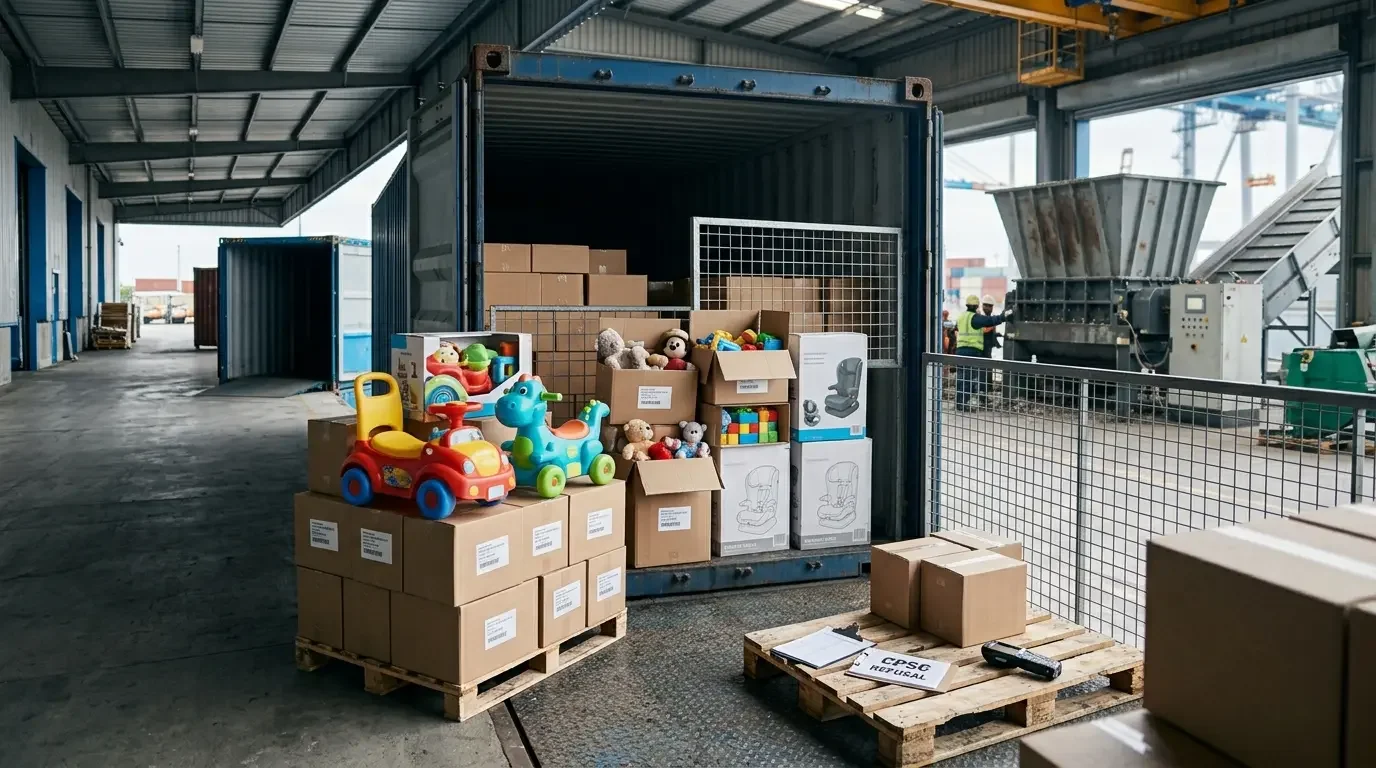
The Consumer Product Safety Commission screens imported consumer products at the border, and children’s products receive the closest attention. When a shipment fails, the result is not a fine and a second chance. The law starts from the position that refused products are destroyed.
Importers of toys, children’s apparel, juvenile products, electronics, and household goods all face this risk. This guide covers why CPSC refuses shipments, how the export option works, and what happens when destruction is the only way out.
Why CPSC Refuses Admission
Under the Consumer Product Safety Act, an imported consumer product can be refused admission if it:
- Fails to comply with an applicable consumer product safety rule
- Is not accompanied by a required certificate, or the certificate is false or misleading
- Is determined to be an imminently hazardous consumer product
- Has a product defect that constitutes a substantial product hazard
- Comes from a manufacturer that has not allowed required inspections
In practice, the most common problems involve children’s products: lead content in paint or substrates above the legal limit, phthalates in toys and child care articles, small parts that create a choking hazard, and missing or defective Children’s Product Certificates based on third-party testing.
Destruction Is the Default
This is the point many importers do not expect. Under the statute, a product refused admission is destroyed unless CBP permits it to be exported instead. If export is approved but the owner does not export the product within 90 days of that approval, the product is destroyed.
The costs fall on the importer. Expenses for destruction, storage, cartage, and labor are paid by the owner or consignee, and unpaid costs can become a lien against future importations. A refused shipment that is ignored does not go away. It follows the importer into the next entry.
Is Reconditioning an Option?
In some cases, CPSC may allow products to be released under bond so they can be modified to comply, for example by relabeling or correcting a certificate. This is only possible when the product can actually be brought into compliance. A toy with lead paint or a crib with a design defect usually cannot be fixed economically.
When Export Does Not Make Sense
- The supplier will not take the goods back or has stopped responding
- Return freight and handling cost more than the product is worth
- The product is unsafe and the importer does not want it sold anywhere under its name
- The export window is too short to arrange shipment and paperwork
Exporting unsafe children’s products to another market can also create reputational risk. Destruction removes the product permanently and produces a clean record.
How CPSC-Refused Cargo Is Destroyed
Toys and Juvenile Products
Shredded so that no usable or resaleable product remains. Products with batteries or electronic components have those removed and handled separately first.
Children’s Apparel and Textiles
Shredded rather than donated. Donation would put the same non-compliant product into children’s hands.
Electronics and Battery-Powered Products
Lithium batteries are separated before shredding to prevent fires, and the batteries are routed to appropriate recycling.
Packaging and Labels
Branded packaging, certificates, and labels are destroyed along with the product so they cannot be reused on other goods.
Documentation to Keep
The record should reference the entry number and the refusal notice, identify the product by SKU, model, or lot and quantity, and state the method, date, location, and facility. If CBP supervised the destruction, note it. Keep the record with your entry file and your testing records, since your next shipments from the same supplier may receive closer scrutiny.
Resolve the Refusal Cleanly
At importdestruction.com, we coordinate the destruction of CPSC-refused shipments with your customs broker, handle batteries and electronics correctly, and issue a Certificate of Destruction referencing the entry on every project.
Contact our team today to arrange compliant destruction of refused consumer products at ports across the United States.